
National cybersecurity starts in the community. A secure nation needs local people who can help other local people stay safe online.
Start Where the Risk Is
People use WhatsApp, Facebook, email, online banking, mobile apps and cloud services every day. When something goes wrong, many do not know what happened, what to do next, or where to get trusted help. Common problems include phishing, fraudulent links, WhatsApp scams, stolen social-media accounts, weak passwords, impersonation, malicious applications, privacy loss and online harassment.
Cyber Shield starts at this level. The purpose is practical cyber self-defence.
- Protect WhatsApp, email and social-media accounts
- Use strong passwords and multi-factor authentication
- Identify phishing, scams and fake links
- Protect personal information
- Secure phones and other devices
- Know what to do when an account is compromised
Cyber Shield provides practical digital safety skills for everyday Internet users.The objective is simple: help people protect themselves and help others around them.
Build Local Cyber Support
Training becomes more useful when knowledge remains inside the community.
A trained person in a village, school, community organisation or youth group can become a trusted first contact when somebody needs basic cyber help. People may need help because a WhatsApp account was taken over, a fake Facebook profile was created, a suspicious message was received, or personal information was exposed online. Many of these cases first need someone who can identify the problem, provide basic guidance and refer serious incidents to the correct organisation.
Local knowledge. Local people. Local support.
SSF’s proposed cyber-defence work follows this approach through trained volunteers, regional contacts, professional guidance and referral pathways for serious incidents.
A community cyber volunteer provides first-level help and connects serious cases with professional support
Take Cyber Defence into Schools
Schools form the next community.
Young people use social media, online learning, gaming, smartphones and generative AI every day. Being comfortable with technology does not automatically mean understanding cyber risk.
SSF’s Cyber Defence approach can train students and teachers together.
- Safer use of social media and messaging
- Account and password security
- Phishing and scam awareness
- Privacy and digital footprints
- Responsible use of AI
- Basic cybersecurity and defensive concepts
Teachers are important because they can continue cyber-safety education after a workshop ends. Students can also become Cyber Ambassadors who help friends, families and their own communities.
Training students and teachers together allows cybersecurity knowledge to remain within the school community.
Create a Path for Young People
University students and young people interested in technology can move to the next level.
They can develop practical skills in networking, Linux, web security, vulnerabilities, cryptography, incident response and ethical hacking.
Those who develop sufficient skills can progress to Cybersecurity Associate level. This provides a structured step towards professional certifications such as CEH.
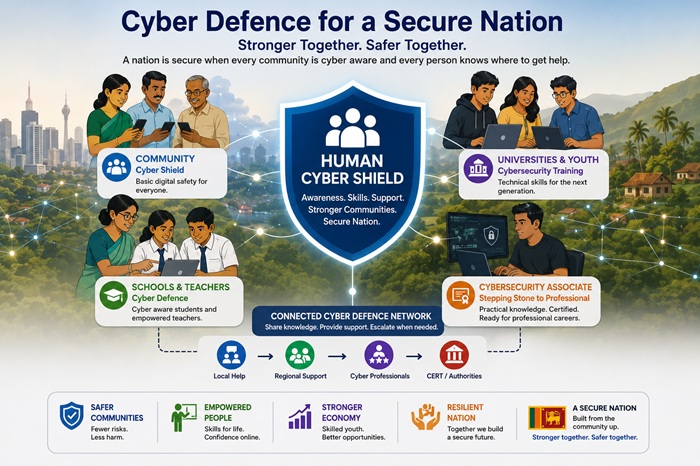
Community → School → University → Cybersecurity Associate → Cybersecurity Professional
The important part is that people moving upward should continue supporting the levels below them.
University students can help schools. Cybersecurity Associates can mentor university students. Professionals can guide Associates and regional volunteers.
A clear progression allows young people to move from cyber awareness into technical training and professional cybersecurityA Community Cyber Defence Model
| Level | Programme | Community Role |
|---|---|---|
| Community | Cyber Shield | Protect yourself and help others |
| Schools | Cyber Defence | Students and teachers spread safer practices |
| University & Youth | Cybersecurity Training | Develop technical volunteers and future professionals |
| Associate | Cybersecurity Associate | Provide skilled first-level cyber support |
| Professionals | Cyber Defence Network | Mentor, investigate and support escalation |
From Training to a Community Network
Training each group separately is not enough. The real value comes from connecting them.
A person facing a cyber problem should not have to search the Internet hoping to find the right answer. A local support network can provide a clear path.
Internet User → Local Cyber Volunteer → Regional Support → Cybersecurity Professional → CERT / Platform / Authority
The local volunteer does not replace a cybersecurity professional. The role is to help locally, recognise what can be handled safely, and know when to escalate.
Local support provides an accessible entry point while serious incidents are referred to higher levels of expertise.Make Cybersecurity Community-Owned
A national programme becomes stronger when communities participate in it.
- Schools can run cyber clubs
- Universities can provide student volunteers
- Teachers can conduct awareness sessions
- Community organisations can identify people who need support
- Cybersecurity professionals can mentor regional networks
Local-language resources are essential. People should be able to understand cyber threats and receive help in the language they normally use.
The result is not simply a group of people who attended cybersecurity training. It is a community capability.
Threat Intelligence Must Reach the Community
Cyber threat information also needs to travel back to ordinary users.
If professionals detect a new WhatsApp scam, phishing campaign or fraudulent website, that information should quickly become a simple community alert.
Threat Detected → Simple Alert → Local Network → Community Action
Communities can also report what they encounter. These reports can help identify new scams and attack patterns.
Threat information moves towards communities while local reports provide feedback on new attacks and scams.Building the Human Cyber Shield
Technology will always be necessary for national cybersecurity. Secure networks, SOCs, threat intelligence, incident response and skilled professionals remain essential.
But cybersecurity also happens in homes, schools, universities and communities.
- Train people locally
- Develop local cyber volunteers
- Connect schools and universities
- Create pathways for young people to become cybersecurity professionals
- Keep professional knowledge connected to communities
Over time, trained people across the country can form a distributed human cyber-defence network.
Every community should have people who understand cyber risk, can provide basic help, and know where to find further support.
That is how cybersecurity education becomes community action.
And that is how a nation can build cyber resilience from the community up.
TechSights: Cyber Security · Community Cyber Defence · Digital Safety · Cyber Education · National Resilience