
Smart Eco Agriculture connects traditional farming knowledge with digital technology to help farmers understand their environment, use resources efficiently and strengthen climate resilience.
Agriculture in a Changing Climate
Farmers have always depended on knowledge of rainfall, soil, water, plants, insects and seasons. Much of this knowledge comes from generations of experience and continuous observation of the local environment.
Climate change is making these decisions more difficult. Changing rainfall patterns, prolonged dry periods, extreme rainfall, rising temperatures, pests and crop diseases can affect agricultural production and rural livelihoods.
Smart Eco Agriculture combines traditional farming knowledge with IoT, sensors, data, artificial intelligence and digital technologies to support productive and environmentally responsible agriculture.
Traditional Knowledge + Environmental Observation + Digital Technology → Better Farming Decisions
From Observation to Data
Traditional farming already involves continuous observation. Digital technology adds the ability to measure, record and analyse environmental conditions over time.
Affordable sensors and connected devices can help farmers and communities monitor:
- Soil moisture
- Temperature and humidity
- Rainfall
- Water levels and availability
- Light and growing conditions
- Crop and environmental conditions
IoT devices can transmit these measurements to mobile phones, computers or online platforms, allowing environmental changes to be observed across hours, days and seasons.
Sensor → Data → Analysis → Decision → Action
The value is not simply in collecting data. The value comes from turning that data into useful information for better farming decisions.
The Smartphone as an Agricultural Tool
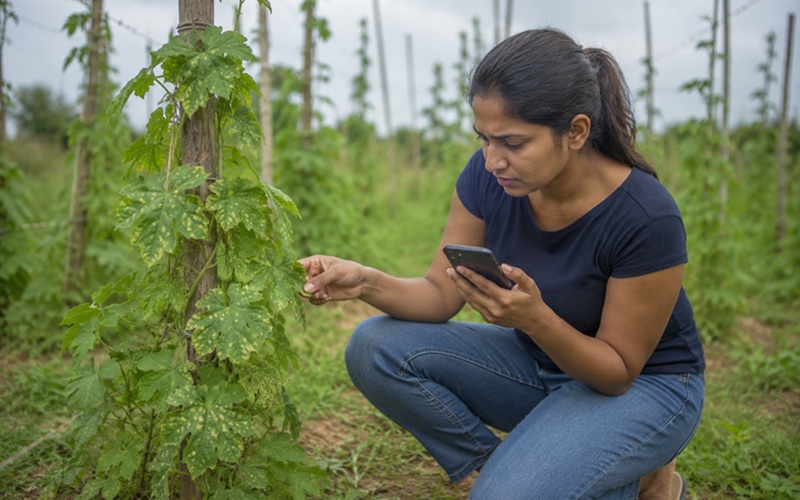
The smartphone can become one of the most accessible tools for Smart Eco Agriculture.
A farmer can photograph an unhealthy leaf, fruit or plant and use digital or AI-assisted tools to help identify possible diseases, pest damage or nutrient problems. Images can also be shared with agricultural officers, researchers or experienced farmers for further advice.
Observe → Photograph → Analyse → Seek Advice → Take Action
Artificial intelligence can assist by comparing images with known patterns and identifying possible problems. It should support rather than replace farmer knowledge and agricultural expertise.
Smarter Use of Water
Water management is one of the most practical applications of Smart Eco Agriculture.
Irrigation is often based on fixed schedules, although crops may not require the same amount of water every day. Soil-moisture sensors can provide a direct indication of when water is needed.
Soil Moisture → Threshold → Irrigation Decision
More advanced systems can combine soil moisture, rainfall, temperature and crop requirements. This can reduce unnecessary water use while helping crops receive water when they need it.
Connecting Agriculture with Climate Technology
Smart Eco Agriculture provides a practical way for communities to use climate technology to strengthen environmental resilience.
Through climate technology projects, local monitoring networks can collect information about rainfall, temperature, soil moisture, water availability, crop conditions and environmental change.
- Local rainfall and weather observations
- Soil and water conditions
- Crop health observations
- Pest and disease reports
- Flooding and drought conditions
- Changes in the local environment
Satellite Data + Weather Data + Local Sensors + Farmer Observations → Local Climate Intelligence
Combining different sources of information can help communities understand environmental conditions at farm and village level and make better-informed decisions as climate conditions change.
Young People as Agricultural Innovators
Smart Eco Agriculture also creates an opportunity to connect STEM education with real agricultural and environmental challenges.
Young people learning electronics, IoT, artificial intelligence and programming can develop practical solutions rather than limiting technology learning to classroom exercises.
- Low-cost soil-moisture monitors
- Automated irrigation prototypes
- Rainfall and weather stations
- Water-level monitoring systems
- AI-assisted crop disease identification
- Farm environmental dashboards
Agricultural Problem → STEM Investigation → Prototype → Field Testing → Local Solution
This approach gives technology education a direct community purpose and creates opportunities for young people, farmers, teachers, universities and agricultural specialists to work together.
Smart Does Not Have to Mean Expensive
Smart agriculture should be appropriate to the community where it is used.
A sophisticated commercial system may offer many functions but remain too expensive or difficult to maintain. A locally developed system using an affordable microcontroller, a few sensors and a mobile interface may solve the immediate problem more effectively.
- Is it useful?
- Is it affordable?
- Can local people understand and use it?
- Can it be maintained or repaired locally?
- Can the community continue using it after the project ends?
This shifts the emphasis from sophisticated technology towards appropriate technology that can deliver practical and sustainable local benefits.
From Smart Agriculture to Eco Agriculture
Increasing agricultural productivity alone is not enough. Technology should also help protect the environmental systems on which agriculture and communities depend.
Smart Eco Agriculture can support more responsible management of:
- Water
- Soil
- Agricultural inputs
- Energy
- Biodiversity
- Agricultural waste
- Local ecosystems
Technology therefore becomes part of an ecological approach to agriculture rather than simply a means of increasing production.
Building Community Climate Resilience
The wider opportunity is to connect agriculture, climate technology, education and community resilience.
| Participant | Contribution |
|---|---|
| Farmers | Local agricultural knowledge and field experience |
| Young People | IoT, AI, data and digital skills |
| Schools | STEM learning and experimentation |
| Community Centres | Technology access and local training |
| Agricultural Experts | Technical and scientific guidance |
| Universities | Research and advanced technology |
| Communities | Local environmental knowledge and priorities |
Farmers provide knowledge of land and crops. Young people contribute digital skills. Schools and community centres support learning, while universities and specialists provide scientific and technical knowledge. Technology becomes a bridge between them.
From Data to Local Knowledge
The future of Smart Eco Agriculture is not simply putting more sensors into farms. It is about transforming observations and data into useful local knowledge.
Observe → Measure → Understand → Decide → Act → Learn
When this cycle is repeated, communities can gradually build their own understanding of changing agricultural and environmental conditions. This knowledge can help farmers manage resources, young people develop practical technology skills and communities become better prepared for climate change.
Technology Rooted in the Community
Sri Lanka has generations of agricultural knowledge, including long-established practices for cultivation, water management and adaptation to local environmental conditions.
Smart Eco Agriculture should build on this knowledge rather than replace it. The opportunity is to connect traditional knowledge with environmental monitoring, IoT, AI and digital information.
When farmers combine their experience with better information, and when young people apply emerging technologies to problems within their own communities, Smart Eco Agriculture becomes more than agricultural technology.
It becomes a pathway towards sustainable livelihoods, local innovation and climate resilience.
The smartest agricultural technology is not necessarily the most advanced technology. It is technology that helps people understand their environment and make better decisions.
TechSights: Smart Agriculture · Climate Technology · IoT · Artificial Intelligence · Environmental Monitoring · STEM · Community Innovation · Climate Resilience