
Cool Rural Cities can combine trees, water, healthy soil, green spaces and community action to create cooler, cleaner and more climate-resilient towns.
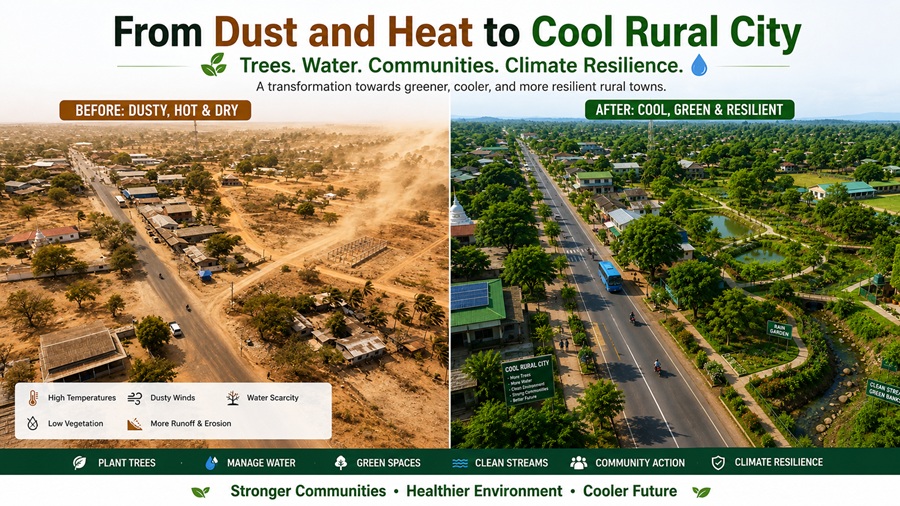
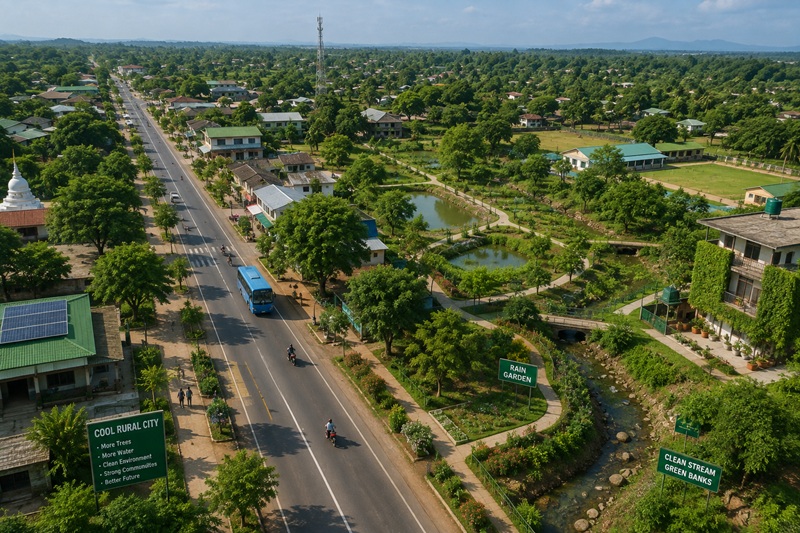
A Cool Rural City integrates trees, water, green spaces and communities into a connected green–blue network.
As Sri Lanka’s rural towns develop, buildings, roads and paved surfaces increasingly replace vegetation and open soil. Natural drainage is disturbed, streams become polluted or obstructed, and large shade trees disappear. The result is often increased heat, runoff, dust, erosion and pressure on drainage systems.
A Cool Rural City approach can integrate tree planting, water conservation, stream restoration, greening and community action into one green–blue infrastructure system.
Trees + Water + Healthy Soil + Green Spaces + Clean Streams + Community Action = Cooler, More Resilient Towns
Build a Network of Long-Living Trees
Long-living, broad-canopy trees such as Bo, Nuga and Jambuk, together with other suitable native and locally adapted species, can provide extensive shade and support cooler local microclimates.
Trees can be strategically planted along roads, schools, markets, public spaces, waterways, religious lands and home gardens. The objective is not simply to plant individual trees, but to create connected green corridors across the town.
Species should be selected according to available space, infrastructure and local environmental conditions—the right tree in the right place.
Bring Water Back into the Landscape
Instead of allowing rainfall from roofs and paved surfaces to immediately become runoff, towns can retain part of it through rain gardens, vegetated swales, infiltration areas, small retention ponds, recharge areas, permeable surfaces and rainwater harvesting.
Slow → Retain → Filter → Infiltrate → Reuse → Release
Retaining water within the landscape also maintains soil moisture and supports vegetation during dry periods.
Develop a Community Urban Ellanga
Sri Lanka’s traditional Ellanga, or cascade system, provides a useful principle that can be adapted to modern rural towns. Instead of depending entirely on large drains, many small water-management elements can be connected.
Roof → Rain Garden → Vegetated Drain → Retention Area → Pond → Stream

Neighbourhood systems can connect with existing tanks, ponds, wetlands and streams, creating a Community Urban Ellanga. The town begins to function like a sponge—capturing water during rainfall and retaining moisture for dry periods.
Restore Streams as Green–Blue Corridors
Streams should be treated as environmental infrastructure rather than waste channels. Communities and local authorities can clean waterways, prevent dumping, protect drainage paths, strengthen vulnerable banks using vegetation and bio-engineering, and restore streamside vegetation.
Where possible, streams can become shaded green–blue corridors supporting drainage, biodiversity, erosion control and cooling.
Green Every Available Space
Where there is insufficient land for large trees, vertical gardens, climbing plants and green façades can increase vegetation. Schools, government buildings, community centres, homes and businesses can use simple trellises and locally suitable plants.
Thousands of home gardens can also contribute through shade trees, fruit trees, vegetable gardens, composting, rainwater harvesting and small infiltration areas. Together they can form a town-wide micro-sponge network.
No Space Left Un-Greened
Reduce Dust with Green Windbreaks
Trees and shrubs can create windbreaks and shelterbelts around exposed land, roads and dusty areas.
Ground Cover → Shrubs → Medium Trees → Taller Trees
This can reduce wind speed, control wind-blown soil and trap dust while remaining sufficiently open to maintain natural ventilation.
Make Schools Climate Innovation Hubs
Schools can become demonstration and learning centres where students establish tree nurseries, rain gardens, vertical gardens, composting, rainwater harvesting, weather stations and IoT environmental monitoring.
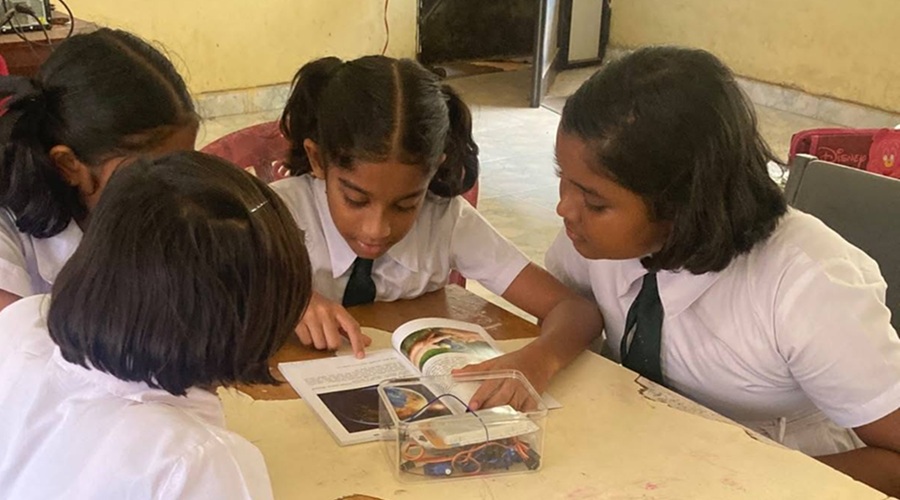
Students can measure temperature, rainfall, soil moisture and vegetation and compare conditions across their communities.
STEM + Climate Technology + Community Action
Build Community Ownership
Long-term success depends on people maintaining what is created. Neighbourhood groups, schools, youth clubs, businesses and religious institutions can adopt trees, streams and public spaces.
Clean → Plant → Restore → Monitor → Maintain
This turns occasional clean-up campaigns into long-term environmental stewardship.
A Multi-Stakeholder Programme
Cooling a town requires cooperation among national government, local government, communities, schools, universities, civil society and businesses.
| Stakeholder | Role |
|---|---|
| National Government | Policy, technical guidance and climate support |
| Local Government | Coordinate land, drainage, waste, waterways and public spaces |
| Communities | Local knowledge, participation and long-term maintenance |
| Schools | Climate education, demonstration and environmental monitoring |
| Universities & Experts | GIS, hydrology, engineering, environmental science and research |
| Civil Society | Community mobilisation, training and coordination |
| Businesses | Resources, technology, nurseries and programme support |
Government enables → Local Government coordinates → Experts support → Schools learn → Communities maintain → Businesses contribute
Map, Measure and Improve
Before interventions begin, GIS can identify tree cover, hot areas, waterways, drainage paths, public land, exposed areas and potential green corridors.
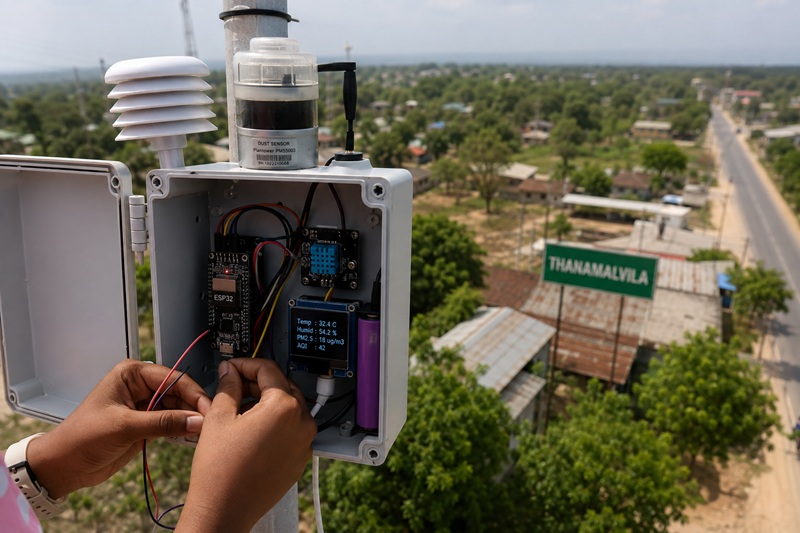
Low-cost sensors can measure temperature, humidity, rainfall, soil moisture, water levels and dust. Satellite information and field observations can complement these measurements.
Observe → Measure → Improve → Monitor → Learn
Start Small and Build a Network
A town could begin with one school, one road, one stream and one neighbourhood. These pilot areas can demonstrate shade trees, stream restoration, windbreaks, rain gardens, vertical greening and environmental monitoring.
Successful interventions can then be connected. A tree-planting project becomes part of a green corridor. A restored stream becomes part of the blue network. A school rain garden becomes part of the urban sponge, while home gardens become part of the wider vegetation network.
From Rural Town to Living Ecosystem
The long-term vision is not simply a town with more trees. It is a town that functions more like a healthy landscape.
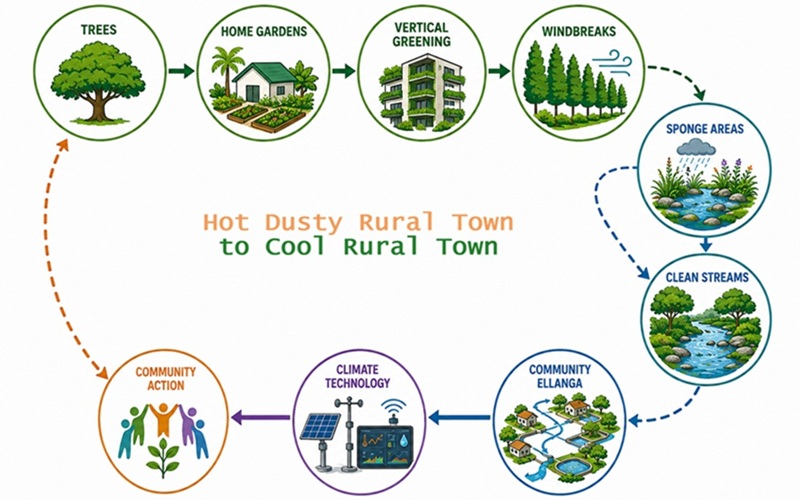
Trees + Home Gardens + Vertical Greening + Windbreaks + Sponge Areas + Clean Streams + Community Ellanga + Climate Technology + Community Action
This approach connects traditional Sri Lankan environmental knowledge with modern climate technology to retain water, reduce heat and dust, protect waterways and strengthen biodiversity and climate resilience.
The objective is larger than beautification. It is to create cooler, cleaner, greener and more water-resilient rural cities through community action.
A climate-resilient town can be grown—tree by tree, garden by garden, stream by stream and community by community.
TechSights: Climate Resilience · Green Infrastructure · Community Ellanga · Urban Cooling · Climate Technology · Environmental Monitoring · Community Innovation